22nd October, 1940
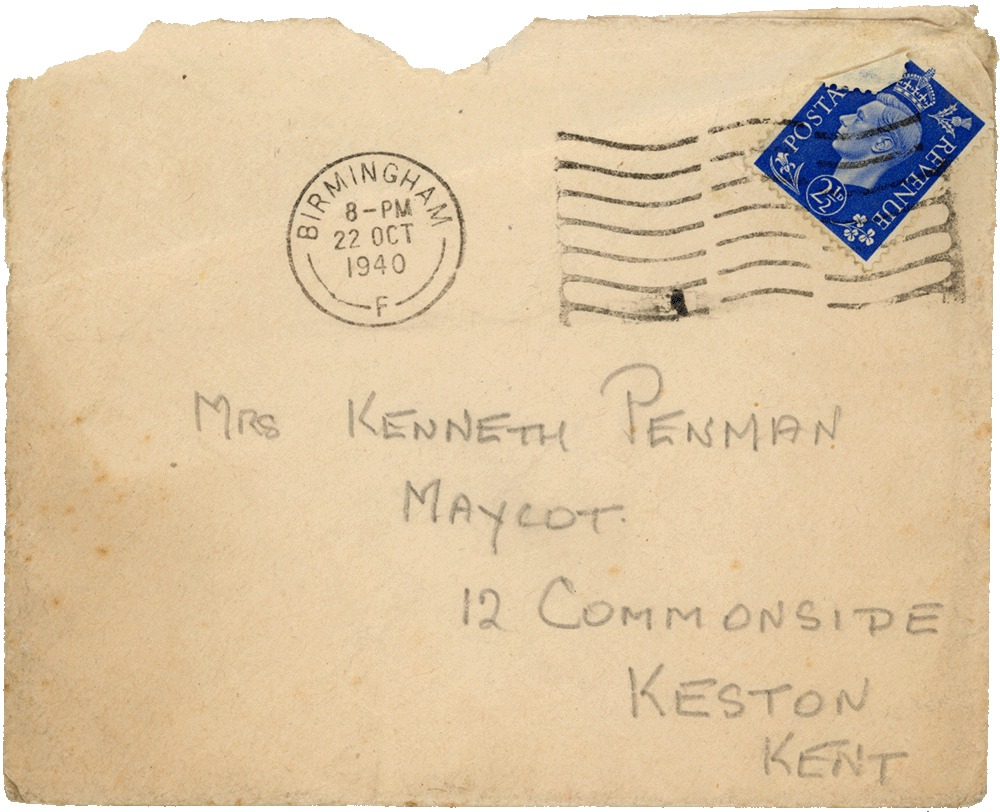
Mrs Kenneth Penman
Maycot
12 Commonside
Keston
Kent
[Postmark: BIRMINGHAM 8 – PM 22 OCT 1940 F]
(1)
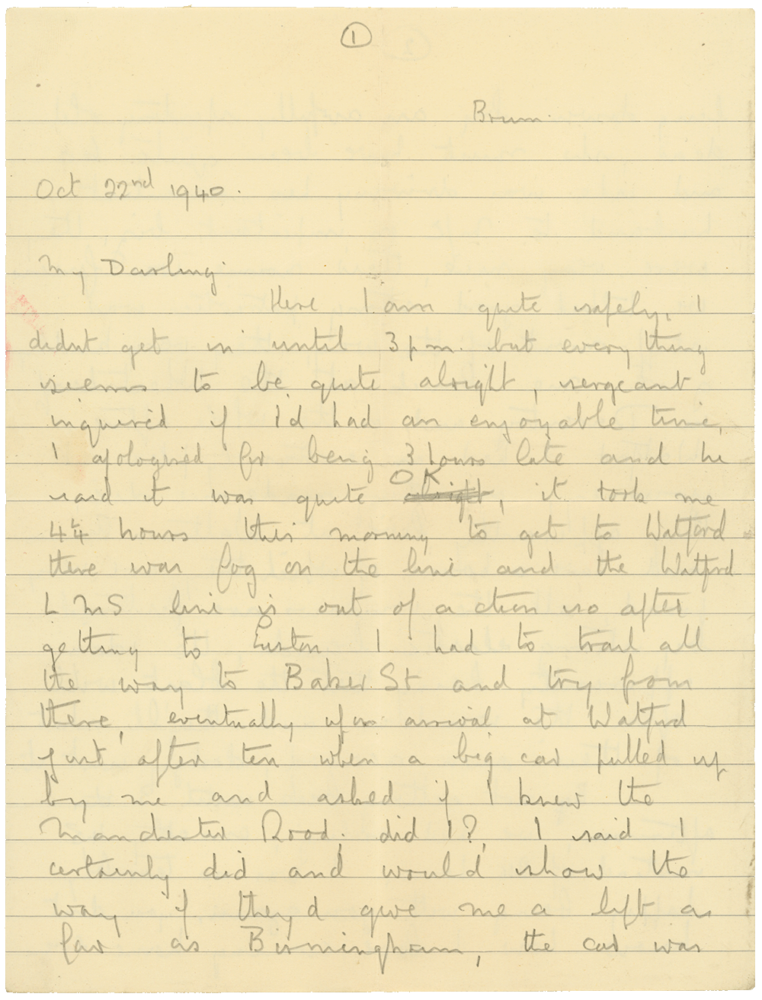
Brum
Oct 22nd 1940.
My Darling,
Here I am quite safely, I didnt get in until 3pm. but every thing seems to be quite alright. Sergeant inquired if I’d had an enjoyable time. I appologised for being 3 hours late and he said it was quite OK.
It took me 4½ hours this morning to get to Watford, there was fog on the line and the Watford L.N.S line is out of action so after getting to Euston I had to taxi all the way to Baker St. and try from there. Eventually, we arrived at Willesden just after ten when a big car pulled up by me and asked if I knew the Manchester Road did I? I said I certainly did and would I show the way if they’d give me a lift as far as Birmingham. The car was…
(2)
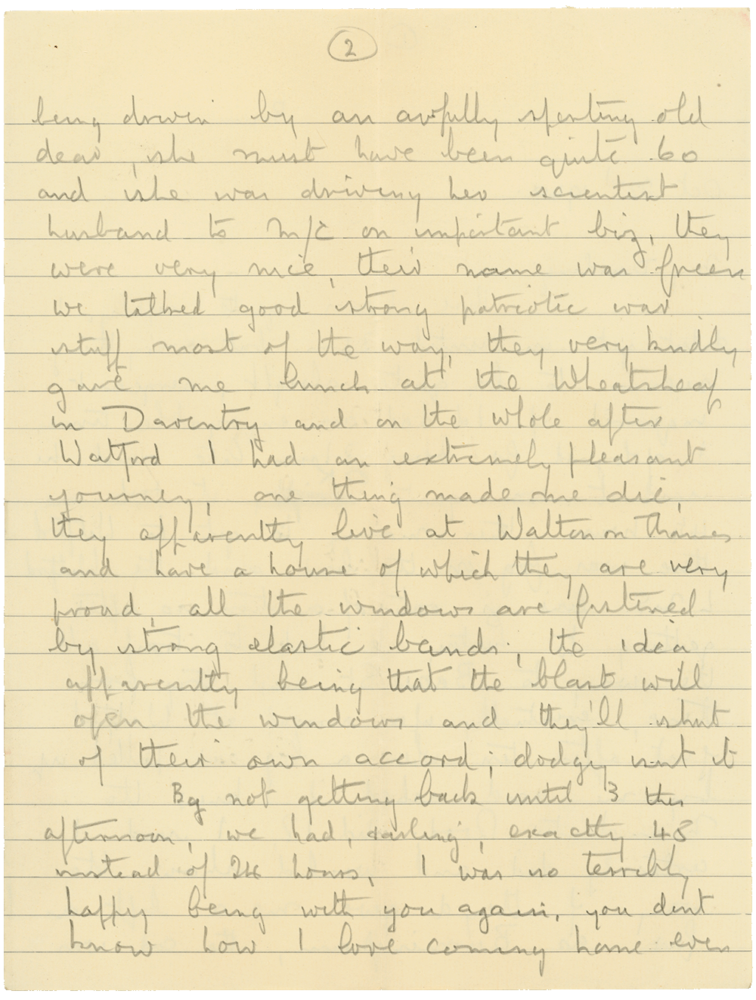
…being driven by an awfully sporting old dear, she must have been quite 60 and she was driving her scientist husband to M/c on important biz. They were very nice, their name was Green we talked good strong patriotic war stuff most of the way. They very kindly gave me lunch at the Wheatsheaf in Daventry and on the whole after Watford I had an extremely pleasant journey. One thing made me die, they apparently live at Walton-on-Thames, and have a house of which they are very fond. All the windows are protected by strong elastic bands, the idea apparently being that the blasts will open the windows and they’ll shut of their own accord. Dodgy isn’t it.
By not getting back until 3 this afternoon we had, darling, exactly 48 instead of 24 hours. I was so terribly happy being with you again, you dont know how I love comming home…
(3)
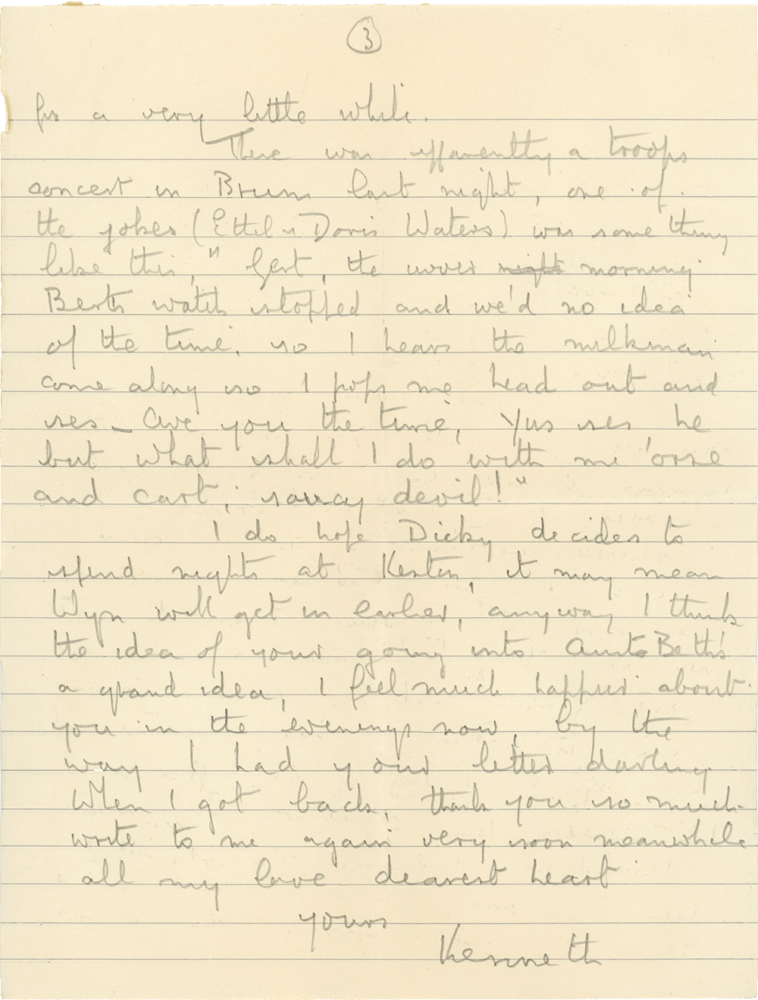
…for a very little while.
There was apparently a troops concert in Brum last night, one of the jokes (Ethel n Doris Waters) was something like this “Gert, the other morning Burt’s watch stopped and we’d no idea of the time. So I heard the milkman come along so I put me head out and ses “‘Ave you the time”, “Yus” sez he “but what shall I do with me ‘orse and cart?” Saucy devil!
I do hope Dicky decides to spend nights at Keston, it may mean Wyn will get in earlier. Anyway I think the idea of your going into Aunt Beths a grand idea, I feel much happier about you in the evenings now. By the way I had your letter darling when I got back, thank you so much write to me again very soon meanwhile all my love dearest heart,
yours
Kenneth
Tuesday 22nd October, 1940:
- Monday 14th October, 1940—The Luftwaffe unleashes its heaviest raid on London to date, causing catastrophic damage and civilian casualties, including the tragic Balham station disaster.
- Tuesday 15th October, 1940—Repeated night bombings inundate London’s financial heart, igniting widespread fires and challenging emergency response capabilities.
- Wednesday 16th October, 1940—The United States implements its first peacetime draft, an unprecedented measure strengthening prospective Allied manpower.
- Thursday 17th October, 1940—RAF Bomber Command intensifies counteroffensives against industrial centers in the German Ruhr region, reflecting Britain’s evolving offensive strategy.
- Friday 18th October, 1940—German U-boats escalate attacks on Atlantic convoys, impeding maritime supply routes and testing British naval escort tactics.
- Saturday 19th October, 1940—The Luftwaffe broadens its assault, targeting provincial industrial hubs to erode Britain’s material resilience.
- Sunday 20th October, 1940—British radar networks and Fighter Command interception protocols advance in sophistication, curbing the tactical advantages of nighttime enemy incursions.
- Monday 21st October, 1940—Civic authorities intensify blackout measures and upgrade public shelters, striving to safeguard London’s population from ongoing aerial bombardments.
- Tuesday 22nd October, 1940—As raids persist, British officials consider dispersal of governmental functions and key industries, aiming to reduce vulnerability to concentrated attacks.